Feed on
Posts
Comments

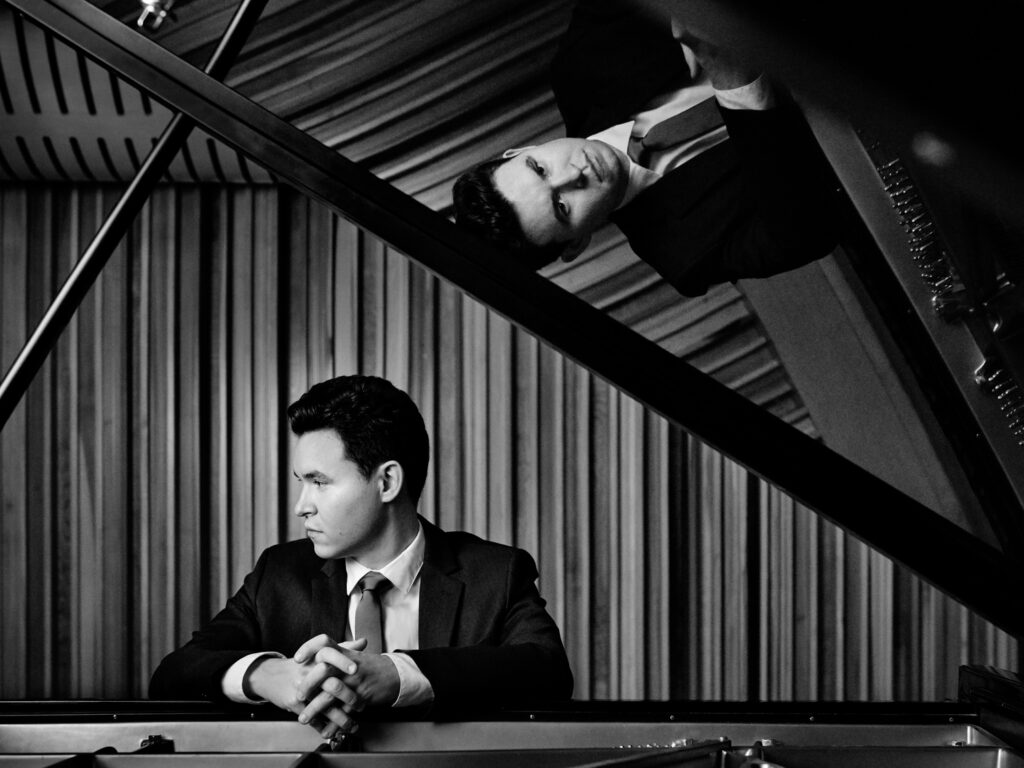
Today’s brand new edition of American Public Media’s Performance Today features Chopin Project Artistic Director, Arthur Greene’s live performance of “Three Ecossaises,”  Opus 72, in the program’s first hour.  

Performance Today is broadcast on 245 public radio stations across the country and reaches 1.1 million listeners each week. Since each station decides what time to air the program, the most direct route to hear the show is the Performance Today website (Program Archive June 1, 2009) until Tuesday, June 7th. 

On an earlier Performance Today program, host Fred Child, described the Chopin Project as

“. . . working towards being a comprehensive site of information about and music by, Frederic Chopin: lots of audio, lots of news bits, and . . . even a Chopin quotepage!. This is kind of Wikipedia-style project and they’re inviting YOUR feedback and YOUR information as well. ”

Download the sheet music and learn more about “Three Ecossaises,” Op. 72 at our earlier posting by clicking – here

We thank you for your comments! 

  • Share/Bookmark

“One is loath to believe that the echo of Chopin’s magic music can ever fall upon unheeding ears.  He may become old-fashioned, but, like Mozart, he will remain eternally beautiful.”

Even for a piece barely more than a minute in length, the “eternally beautiful” Chopin cited by writer and pianist james Huneker (author of the definitive book Chopin: The Man and his Music) is evident in this brief Cantabile.    This little gem often turns up folios and other albums devoted to 19th-century miniatures, though it didn’t actually appear in print until 1931, nearly 100 years after Chopin compoosed it.

Cantabile, after all, is defined as “to sing or play in a sweetly singing manner.”  See if you don’t think that’s exactly what Chopin Project Pianist Noel McRobbie does in this performance…

favicon

Download a Public Domain edition of the sheet music here at the International Music Score Library Project (IMSLP).

  • Share/Bookmark

Chopin Project Artistic Director Arthur Greene calls Chopin’s last nocturne a curious, but moving, work:

“It is rarely played.  Its absolute simplicity of texture may lead performers to experiment with ornamentation, but I believe that it is an expression of Chopin’s new direction, in the difficult few years at the end of his life, towards a directness and purity of expression.  The Polonaise-Fantasy has somewhat the same mood, although it is much more elaborate.  The little nocturne is a tragic whisper.”

Chopin Biographer Arthur Hedley once wrote: “From the great Italian singers of the age [Chopin] learned the art of ’singing’ on the piano, and his nocturnes reveal the perfection of his cantabile style and delicate charm of ornamentation.”

Recent scholarship by some musicologists hear the song of a sorrowful Venetian gondolier (borrowed from Italian opera composer Giaocchino Rossini, whom Chopin greatly admired) in the undulating Nocturne in C minor, the 21st and final essay in the genre that Chopin perfected. It dates from 1847, just two years before Chopin’s death, but was not published until decades later.

favicon

Hear Chopin Project Artistic Director Arthur Greene perform Chopin’s haunting Nocturne in C Minor, KK 1233-5, in live performance at the University of Michigan’s Britton Recital Hall.

Get the music at here at the pianosociety website.


  • Share/Bookmark

Click on our new feature, The Chopin Planet, for a captivating musical experience.   You’ll see a compelling  visual representation of Chopin’s universal appeal … how his music literally spans the globe.  From São Paulo to Siberia, (or perhaps from Waco, Texas to Warsaw!). Check out in real time who’s online and sharing the same Chopin experience.

Watch, listen and share your thoughts and feelings with a worldwide community!

  • Share/Bookmark

Wessel Edition Cover page: Chopin\'s Impromptu No. 2 For years one of the knocks on Chopin’s music is that he was a “ladies’ composer,” spinning out his piano pieces for the sighing, swooning denizens of Parisan salons, the result being that his remarkable compositions were often trivialized or marginalized.

According to the Cambridge Companion to Chopin, the composer hated the association:

“Chopin enjoyed elegant feminine company, but he had harsh views of the fawning of his ‘adoring women.’ He himself used the phrase ‘music for the ladies’, but unhappily he meant it disparagingly. Another association with the salon was the ’sentimental drawing room composer” – the ’superficial genius’ – and the appellation was encouraged by a self-imposed limitation of meidum, but the connotations of small forms, and by the description titles assigned to his music by publishers…”

One publisher in particular who drew Chopin’s ire was a London-based German entrepreneur named Christian Rudolph Wessel. As you can see by the cover page, above, (courtesy of the fantastic Chopin Early Editions site at the University of Chicago) the publisher issued Chopin’s marvelous Impromptu No. 2 in a series he called “Les Agrémans au Salon” — loosely translated as “Drawing-Room Trifles.” With “friends” like that….

favicon


Nowadays, Chopin’s Impromptus are a robust staple of the concert hall. Hear pianist Noel McRobbie perform Chopin’s Impromptu No. 2 in F-sharp Major, Op. 36, in a concert performance at the University of Michigan’s Britton Recital Hall.

Download the sheet music from the Piano Society web site.

  • Share/Bookmark

Today’s edition of Performance Today – the most popular classical-music show in the USA – will feature a performance from The Chopin Project: Chih-Long Hu’s live interpretation of Chopin’s Waltz in A-flat, Op. 69, no. 1 “L’Adieu”

Produced and distributed by American Public Media, Performance Today is broadcast on 245 public radio stations across the country and is heard by about 1.1 million people each week. Each station individually decides what time to air the program. You’ll also be able to hear the show on the Performance Today website (Program Archive July 9, 2008) until Tuesday, July 15th.

  • Share/Bookmark

Original Published Score - Chopin Mazurka in C

“In his Mazurkas, you get to know the very soul of Poland and Chopin never forgot his home land or the poor farmers singing the Mazurkas during the time of harvest.” All right, the Piano Society’s prose on Chopin’s 58 Mazurkas may be a bit purple, but it does appear that the Mazurkas are close to Chopin’s Polish soul. Esteemed pianist and scholar Charles Rosen has also declared the Mazurkas as Chopin’s “R & D Lab” – where some of the composer’s boldest harmonic experiments can be found.

Although this sprightly and march-like Mazurka in C major dates from Chopin’s younger years, (see this posting to discover what the “KK” designation means), it wasn’t published until 1870. The original published score (above) comes from the excellent Chopin Early Editions site maintained by the University of Chicago.

favicon


Hear pianist Noel McRobbie perform Chopin’s Mazurka No. 56 in C major in concert at the University of Michigan’s Britton Recital Hall.

Get the music at Sheet Music Plus.


  • Share/Bookmark

Decades before Maurice Ravel came along, Chopin also found inspiration in the old Spanish dance known as the Bolero, defined as “A Spanish dance and song, in moderate tempo and triple metre, popular at the end of the 18th century and throughout the 19th, often performed with guitar and castenets.” In fact, the Spanish Bolero was rythmically related to the polonaise of Chopin’s native country, and even Beethoven wrote a Bolero a solo … it’s one of his minor “without Opus” works, WoO 158.

Regardless of origin or inspiration, it’s one of Chopin’s more unusual works, dating from 1833. He tacked on an Introduction in C major that serves as an evocative attention-getter that sets up the uniquely Spanish-Polish Bolero that follows.
favicon
xiaofang wu

Hear pianist Xiaofeng Wu perform Chopin’s Introduction & Bolero in A, Op. 19 in concert at the University of Michigan’s Britton Recital Hall.

Get the music at Sheet Music Plus.


  • Share/Bookmark

This delicate, haunting Waltz in another work that adds to the mystery and mastery of Chopin. This Waltz has long been a favorite of amateur pianists, as it’s one of the least difficult pieces of Chopin’s to play. Well, the NOTES may not be hard, but the FEELING? Rarely is this piece performed with such sensitivity, transparency and grace.

favicon

Hear Chopin Project pianist Christina Thayer Fox perform Chopin’s Waltz in A minor.

Now, for the mystery part: There is a lot of confusion over the title and date of this Waltz. It was published after Chopin’s death, and therefore carries no opus number (It is not to be confused with the Waltz in A Minor, Op. 34, No. 2). In fact, the most popular published score didn’t appear until 1955! So as a result it can be harder to track down recordings and scores….so we’ve done it for you!

favicon

Click here to download the score to Chopin’s Waltz in A minor (B. 150).


  • Share/Bookmark

I am compelled to think about paving my way in the world as a pianist.” – Shortly after arriving in Paris Chopin penned those memorable words in a letter to his old Warsaw music teacher Józef Elsner. And one of the first pianistic roads Chopin paved in his own way was through the development of the Nocturne, a form more or less invented by the Irish composer John Field, but, quoting the Guild Music website: “it was Chopin who brought the genre to its perfection. In his Nocturnes, he displays his unique melodic gift (very much influenced by the bel canto operas of his time) and his extraordinary ability to renew the accompaniment.”

Chopin’s development of the Nocturne form really came into its own with the publication of his Three Nocturnes, Op. 15 in the early 1830’s. Today’s entry – The Nocturne in G minor, Op. 15, No. 3 – showcases Chopin’s incredible gift for opera-like melody at the beginning and end of the piece, contrasted by a fierce, fiery and virtuosic middle section.

favicon

Hear Chopin Project pianist Christina Thayer perform Chopin’s utterly original Nocturne In G minor, Op. 15, No. 3.

Ferdinand Hiller, dedicatee of Chopin\'s Op. 15 NocturnesFerdinand Hiller, dedicatee of Chopin’s Op. 15 Nocturnes

Chopin dedicated the Op. 15 Nocturnes to his friend and mentor Ferdinand Hiller, a German composer, conductor, and pianist whose own music has been almost totally forgotten, but whose name lives on as the dedicatee both of these Chopin masterworks as well as Robert Schumann’s Piano Concerto.

Want to try playing it yourself? Download the sheet music here.

Read the Wikipedia entry here.

Read the Chopinmusic.net entry on the Nocturnes here.

  • Share/Bookmark

Older Posts »